The success of a project is measured by its timely completion to specification within the budget allocated. However, in the execution of any project there is invariably an element of risk involved (Radhakrihnan, 1999): especially construction is a highly risky business, where the level of risk is considered much higher than in other types of economic activities (Abdul-Rashid, 2004).
All parties take some form of risk when they enter into contract. The acceptance of an obligation brings with it the acceptance of a commensurate risk, i.e. the risk of being unable to fulfill the obligation because one’s own inadequacy, incapacity, inadvertence or error, or because of interference from outside sources or supervening events (Robinson et al. 1996).
Risks are inevitable and cannot be eliminated. They can, however, be transferred (Murdoch and Hughes, 2000). One of the main roles of a contract is to distribute risks between the parties. Standard forms of contracts contained express risks distributing provisions. Risk transferring contracts commonly exist between the various parties concerned in the field (Robinson et al. 1996).
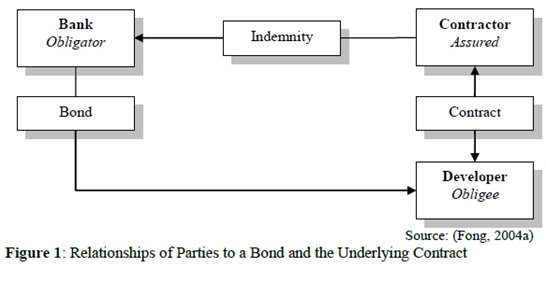
The purpose of a bond is therefore to provide the employer with some financial security in the form of a cash payable by the bank or insurance company (in return for payment of a premium) for the benefit of and at the request of the employer, in a stipulated maximum sum of liability and enforceable by the employer in the event of the contractor’s default, repudiation or insolvency (Robinson et al. 1996). These relationships can be illustrated in Figure 1.