
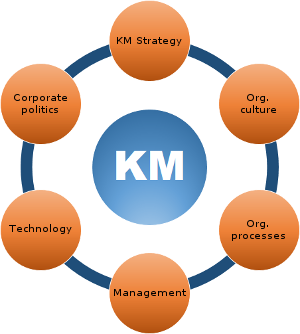
The time of rapid technological change is the time of nonstop struggle for maintaining a competitive advantage for many organizations. It is obvious that knowledge is slowly becoming the most important factor of production, next to labor, land and capital. Knowledge Management is a process that through creating, accumulating, organizing and utilizing knowledge helps achieve objectives and enhance organizational performance. Knowledge Management also consists of strategy, cultural values and workflow.
 The positive impact on organizational performance is one of the key benefits of introducing knowledge management practices in organizations. Based on the academic researches, Knowledge management positively affects organizational outcomes of company innovation, product improvement and employee improvement. There is a strong positive relationship between a knowledge management process and operational and organizational performance. Still, it is not well understood how different knowledge management strategies affect organizational performance.
The understanding of these knowledge management factors performs as a basis in determining the type of knowledge management strategies and plans for an organization. The value that knowledge management adds lays in increasing individual, team and organizational efficiency through the use of knowledge management tools such as information technology.
•Capturing knowledge: the higher the level of capturing knowledge (explicit or tacit) with information technology tools, the better result of the knowledge management.
•Usage of IT tools: the higher the quality of tools, quality of information, user satisfaction, usage and accessibility, the greater the knowledge management effect on organizational performance.